Seventy-five percent of customer conversations will be handled by AI or automation by this year, according to Gartner. Most businesses aren't ready for that shift. Not because they don't have the technology available to them, but because they're still thinking about call volume as a staffing problem.
Here's what that looks like in practice: a product launch goes well, a campaign lands, a seasonal spike hits, and suddenly your phones are ringing at 3x the normal rate. Your team is overwhelmed. Hold times stretch. Customers abandon. Leads go cold. And someone in leadership says the words every ops manager dreads: "We need to hire more people."
If you're reading this, you've probably been in that room. You know the feeling of watching growth create pain instead of opportunity.
The truth is, you don't have a staffing problem. You have a call infrastructure problem. And this article will show you exactly how to solve it, without a single new hire.
Here's what you'll learn: why traditional hiring fails to scale, what a smarter architecture actually looks like, and five concrete strategies to scale call volume without expanding your headcount.
Why Hiring More People Is the Wrong Default
The Hidden Math of Headcount
Hiring feels like the obvious answer. More calls, more people. It's linear. It's familiar. It's also expensive in ways that don't show up on the first invoice.
Consider what a single new call center hire actually costs: recruitment time (often six to eight weeks), onboarding, training, salary, benefits, management overhead, and the very real possibility that the spike is seasonal and you'll be overstaffed in three months. Staffing costs account for up to 70% of call center operating expenses, according to research on UK contact centers. That's not a cost you want to replicate every time your phone rings more than usual.
More critically, headcount doesn't scale the way demand does. A campaign can double your call volume overnight. A hiring cycle can't respond in the same timeframe. You're always chasing a moving target.
The Burnout Feedback Loop
There's a darker side to the "just hire more" approach. When you're understaffed during a surge, existing agents absorb the overflow. They handle back-to-back calls without adequate breaks. Quality drops. Mistakes happen. Satisfaction scores fall. And your best people, the ones who have the institutional knowledge you'd actually miss, start looking elsewhere.
I've personally seen this play out in the businesses we work with at OnDial. The calls keep coming. The team keeps shrinking. The problem compounds itself.
What "Scaling Call Volume Without Hiring" Actually Means
Scaling call volume without hiring is the practice of building a call infrastructure that grows its capacity automatically in response to demand, without requiring proportional increases in human staffing.
This is not about replacing your team. It's about redesigning what your team is responsible for.
The Architecture Shift Most Businesses Miss
Most businesses treat their call systems as a funnel: calls come in, agents answer, problems get solved. That model works at low volume. It collapses under pressure.
The smarter model is layered. Think of it as a call architecture with three tiers: an automated first-response layer that handles high-volume, routine inquiries; an intelligent routing layer that matches complexity to capability; and a human expertise layer reserved for the calls that genuinely require a person's judgment, empathy, or authority.
When these layers are designed to work together, your team's effective capacity multiplies without adding headcount. Ten agents functioning inside a well-designed system can handle what would previously have required thirty.
What AI Voice Assistants Actually Do on a Call
An AI voice assistant is a conversational AI system that answers inbound calls, understands the caller's intent through natural language processing, and either resolves the inquiry or routes it to the correct human agent with full context already attached.
This isn't the robotic IVR system you're imagining. Modern voice AI, particularly the kind built on large language models, holds natural conversations. It understands context, handles interruptions, adapts to different accents, and maintains tone consistently across every single call, whether it's the first of the day or the ten thousandth.
(And yes, I know what you're thinking: "But can it really handle my customers?" I'll address that directly below.)
Five Strategies to Scale Call Volume Without Expanding Headcount
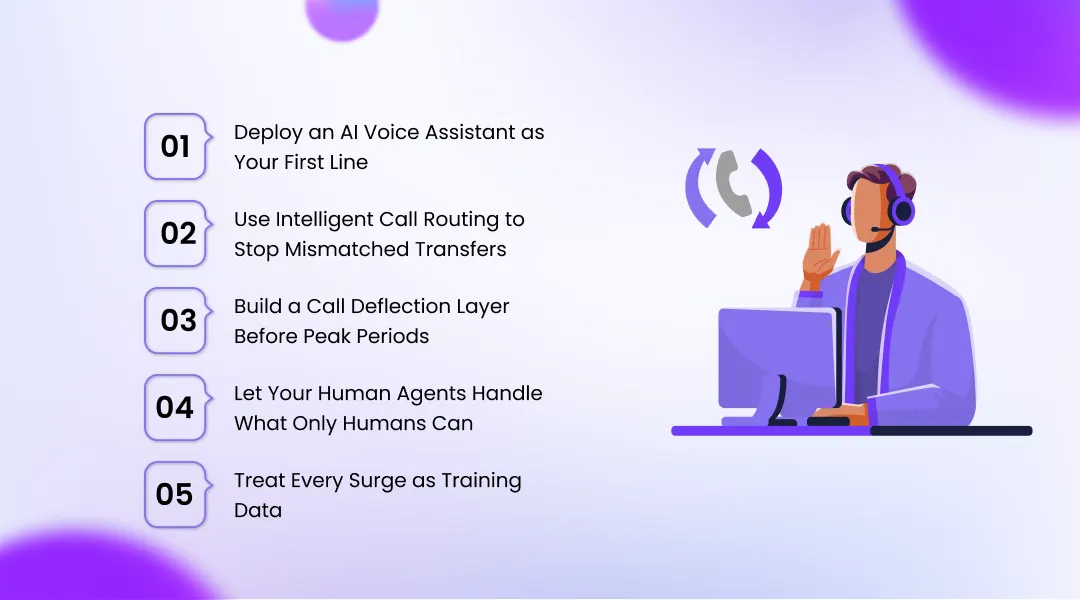
Deploy an AI Voice Assistant as Your First Line
The most immediate way to scale call volume without hiring is to put an AI voice assistant at the front of your call queue. Not as a gatekeeper or a frustration mechanism, but as a capable first responder.
At OnDial, we build these voice AI systems to handle the calls that represent the majority of inbound volume: appointment confirmations, order status inquiries, FAQs, account lookups, basic troubleshooting. These call types typically represent 70% to 80% of total volume for most businesses.
When your AI handles that 70%, your human agents suddenly have capacity to give real attention to the remaining 30%. Their quality of engagement goes up. Their burnout risk goes down. And your customers, the ones with genuinely complex issues, get a faster path to a real person.
Featured snippet answer: How do you handle a sudden spike in call volume? Deploy an AI voice assistant to absorb routine inquiries (typically 70-80% of volume), use intelligent call routing to direct complexity to the right agents, and build pre-configured overflow protocols so surge capacity activates automatically without manual intervention.
Use Intelligent Call Routing to Stop Mismatched Transfers
Intelligent call routing, also called skill-based routing or ACD (Automatic Call Distribution), is the process of matching each inbound call to the agent or channel best equipped to resolve it, based on caller intent, issue type, agent expertise, and real-time availability.
Bad routing is one of the most expensive invisible problems in call operations. A customer transferred three times before reaching the right person isn't just frustrated. They're less likely to buy again, more likely to leave a negative review, and more likely to call back, adding to your volume without adding value.
Smart routing, especially when powered by an AI voice platform, solves this at the intake stage. The system identifies intent during the first ten seconds of the call and routes accordingly, before any agent time is spent on the wrong conversation.
Build a Call Deflection Layer Before Peak Periods
Call deflection is the practice of resolving customer needs through a channel other than a live voice call, typically through self-service options, SMS follow-up, or automated outbound notifications that answer questions before customers even pick up the phone.
Research from 8x8 found a 29% drop in call volumes after businesses rolled out AI-assisted messaging workflows. That's nearly a third of your inbound load, handled before it ever reaches your phone system.
The key insight here is timing. Deflection works best when it's proactive, not reactive. If you know a billing cycle creates a predictable spike, sending an automated message answering the three most common questions before that spike hits means your phones ring less. Not because fewer people have questions, but because their questions are already answered.
Let Your Human Agents Handle What Only Humans Can
Here's the counterintuitive part of this strategy: to scale call volume without hiring, you need to be more deliberate about what your human agents actually do.
When agents spend their time on routine, repetitive calls, they aren't delivering value proportional to their cost or capability. They're managing volume, not solving problems. That's a poor use of their skills and a significant contributor to burnout.
Companies using AI in customer interactions have seen a 22.3% improvement in customer satisfaction scores, according to research aggregated from Mordor Intelligence, MarketsandMarkets, and The Business Research Company. The reason isn't that AI is warmer than a person. It's that AI handling routine volume frees human agents to be genuinely attentive on the calls that matter most.
So ask yourself: what are the call types where a human's presence, empathy, or authority actually makes a difference to the outcome? Protect that space. Route everything else appropriately.
Treat Every Surge as Training Data
This is the strategy most businesses leave on the table. Every call spike is a dataset. It tells you when demand peaks, what your customers are calling about, which call types can be automated, and which scripts need refinement.
AI voice platforms that are built for this, like the ones we develop at OnDial, improve with every interaction. They identify patterns in call intent, flag common friction points, and can be updated to handle new scenarios without retraining a human being. The system gets smarter every time your volume increases.
Over time, the gap between your call capacity and your headcount widens in your favor. Your calls-per-agent ratio improves. Your cost-per-call falls. And when the next surge comes, your infrastructure is already ahead of it.
How to Know If You're Ready to Scale Call Volume Without Hiring
Not every business is at the same starting point. Before deploying a voice AI platform or restructuring your call architecture, it helps to audit three things:
- Call type distribution: What percentage of your calls are routine and repetitive versus genuinely complex? If routine calls represent more than 50% of volume, AI deflection will have an immediate impact.
- Current abandonment rate: How many callers hang up before reaching an agent? High abandonment is usually a capacity signal, not a channel preference signal. AI solves capacity, not channel.
- Agent utilization: Are your current agents averaging above 85% occupancy during peak hours? That's a sign your human layer is already maxed out and the architecture needs an automated buffer underneath it.
If you can answer these three questions, you have enough information to size the opportunity and make a case for investment.
Conclusion:
Scaling call volume without hiring isn't a workaround. It's a better architecture for how modern businesses communicate. The key takeaways: your call infrastructure should grow automatically, not linearly; AI voice assistants handle the majority of routine volume so your human team can focus where they're genuinely needed; and every surge, handled well, makes your system smarter and more resilient.
You don't need more people. You need a smarter system built around the people you already have.
At OnDial, we build AI voice platforms designed for exactly this kind of growth. We're an India-based team with deep experience in conversational AI, and we work as genuine partners to design voice AI systems that reflect how your customers actually communicate, not just how a generic chatbot would. If your phones are the bottleneck between you and your next stage of growth, let's talk about what a tailored voice AI solution would look like for your business.
Growth shouldn't create chaos. The right voice AI architecture means it doesn't have to. If your call volume is already telling you something needs to change, reach out to OnDial and let's build what your team actually needs.